
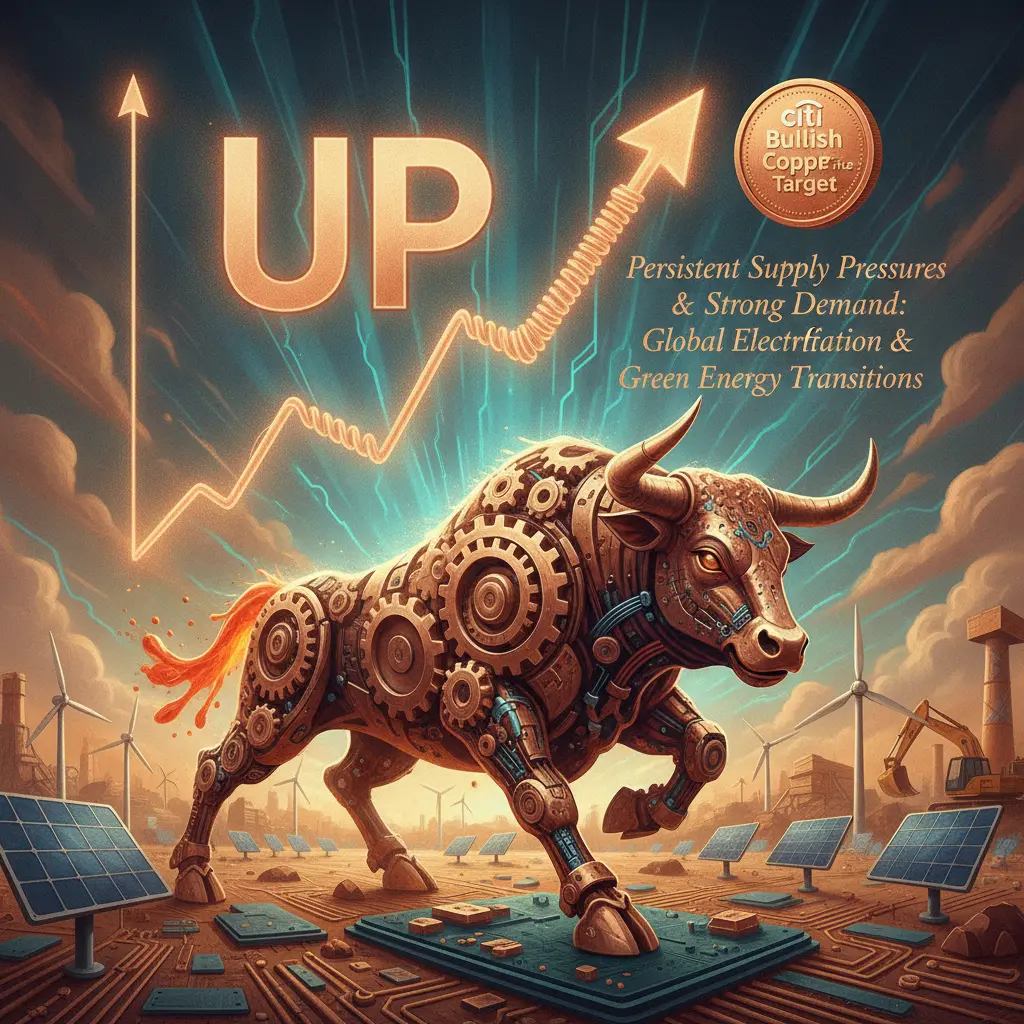
Citi, a leading financial institution, has reiterated its strong bullish outlook on copper, maintaining its elevated price targets amidst growing concerns over global supply pressures. The firm’s analysis, as reported by Mining Weekly, underscores a fundamental imbalance in the copper market, where burgeoning demand continues to outstrip a constrained supply pipeline.
The industrial metal, often seen as a bellwether for global economic health, is facing significant headwinds on the production front. Factors contributing to this supply crunch include complex geopolitical landscapes affecting major mining regions, increasingly stringent environmental regulations, and the natural depletion of high-grade ore bodies, making extraction more costly and challenging. Furthermore, disruptions from labor disputes and unexpected operational setbacks at key mines frequently impact output, adding to market volatility.
Copper’s role in the global transition to a green economy cannot be overstated. It is a critical component in electric vehicles, renewable energy infrastructure like solar panels and wind turbines, and the vast expansion of electrical grids needed to support widespread electrification. This sustained demand, driven by long-term structural trends, creates a powerful tailwind for prices, even as new supply struggles to keep pace. Investors and industry participants are closely monitoring these dynamics. For those tracking the market in real-time, the live Copper price provides immediate insights into how these factors are shaping its valuation.
Citi’s continued confidence in copper’s price trajectory highlights a conviction that these supply-side constraints are not merely transient but rather embedded challenges that will persist for the foreseeable future. This outlook suggests that despite potential short-term fluctuations, the long-term fundamentals for copper remain exceptionally strong, positioning it as a key commodity in the coming decades. Market watchers anticipate that any significant increase in demand, without a corresponding boost in new, sustainable supply, will further exacerbate current pressures and likely support higher price levels. Read More
Leave a Reply
You must be logged in to post a comment.