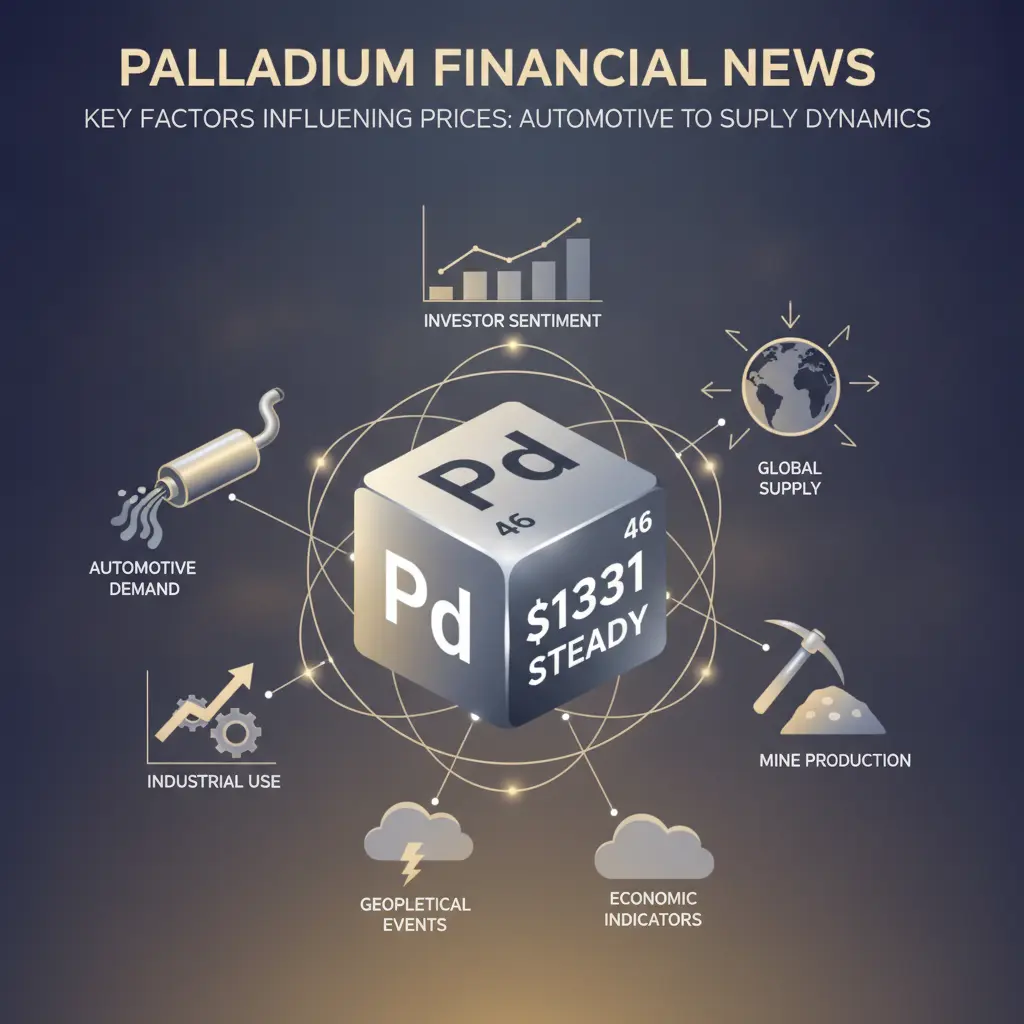
Palladium, a precious metal renowned for its critical role in various industrial applications, currently holds steady on the markets. As of today, the live Palladium price is observed at $1331 USD per troy ounce, showing no change over the past 24 hours. This stability comes amidst ongoing discussions in financial circles about the underlying forces shaping its valuation, a topic recently highlighted by analyses from institutions like CME Group.
The primary driver for Palladium demand continues to be the automotive industry, where it is an indispensable component in catalytic converters. These devices are crucial for reducing harmful emissions from gasoline-powered vehicles, making Palladium intrinsically linked to global automotive production and stricter environmental regulations. While electric vehicles are a long-term threat to internal combustion engine demand, the transition pace and ongoing production of gasoline cars maintain a strong floor for Palladium.
Beyond its automotive utility, Palladium also sees significant demand in electronics, dentistry, and jewelry. Industrial applications, though secondary to catalytic converters, contribute to the metal’s overall consumption profile, reflecting its unique chemical properties.
On the supply side, the market is largely influenced by a few key producing nations, primarily Russia and South Africa. Geopolitical events, mining strikes, and operational challenges in these regions can significantly impact global supply, often leading to price volatility. Any disruption in supply channels can quickly tighten the market, pushing prices higher in response to sustained demand.
Investment demand also plays a role, with investors seeking safe-haven assets or opportunities in industrial commodities. However, for Palladium, fundamental supply and demand dynamics from industrial usage tend to be the dominant factor. The current stability at $1331 per ounce reflects a balanced market for now, but investors and industry players alike remain watchful for shifts in automotive production forecasts, regulatory changes, and any potential supply disruptions that could reignite price movements. Read More
Leave a Reply
You must be logged in to post a comment.