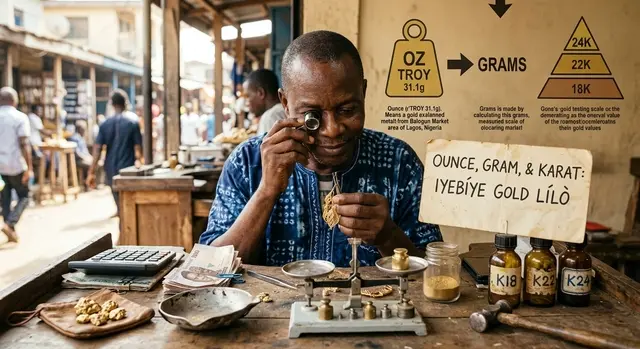
Walk into a jewellery shop in Lagos, Kano or Port Harcourt and ask what gold costs, and you will get a price per gram in naira. Look at any international market feed and you will see a price per troy ounce in US dollars. Those two numbers are the same commodity, but getting from one to the other involves three separate conversions — and a fourth adjustment that almost nobody explains to buyers.
Here is the whole chain, step by step. If you only want the number, skip to the live gold price per gram in Nigeria.
Step 1: The global spot price
Gold has one worldwide reference price, set by continuous trading on the London and New York markets. It is quoted in US dollars per troy ounce of pure gold. Nigeria does not set this price and neither does any individual dealer; a shop in Onitsha and a bank in Zurich are both working from the same number, updated by the second.
The important thing to understand is that spot price refers to pure gold — what the trade calls fine gold, 99.9% or better. Almost nothing sold as jewellery is pure gold, which is where the next two steps come in.
Step 2: Troy ounces to grams
A troy ounce is not the ounce used for food. It weighs 31.1035 grams. This single number is the source of a great deal of confusion, because people who look up “the gold price” find an ounce figure, divide it by 28 out of habit, and end up roughly 10% wrong.
To get the price of one gram of pure gold:
price per troy ounce ÷ 31.1035 = price per gram
On 7 September 2026, 24K gold stood at ₦5,807,047.86 per troy ounce in Nigeria. Divide that by 31.1035 and you get ₦186,700 per gram — which is exactly what the calculator shows.
Step 3: Karat purity
Karat measures how much of an alloy is actually gold, expressed in twenty-fourths. Multiply the pure-gold gram price by the purity factor to get the value of the metal in a given piece. Prices below are as at 7 September 2026 — click any karat for the live figure.
| Karat | Gold content | Multiplier | Per gram (7 Sep 2026) |
|---|---|---|---|
| 24K | 99.9% | 0.999 | ₦186,700.92 |
| 22K | 91.6% | 0.916 | ₦171,189.24 |
| 21K | 87.5% | 0.875 | ₦163,526.84 |
| 20K | 83.3% | 0.833 | ₦155,677.55 |
| 18K | 75.0% | 0.750 | ₦140,165.86 |
| 14K | 58.3% | 0.583 | ₦108,955.59 |
| 10K | 41.7% | 0.417 | ₦77,932.22 |
| 9K | 37.5% | 0.375 | ₦70,082.93 |
Nigerian buyers should pay particular attention to this table, because the karats that dominate here are not the ones that dominate elsewhere. 18K and 21K are the backbone of the Nigerian and wider West African jewellery trade, with 22K common in pieces bought as a store of value rather than as ornament. American shops sell a great deal of 14K, which is why price guides written for a US audience often lead with a karat that is hard to sell locally.
Step 4: The naira exchange rate
The dollar-to-naira rate is the step that makes gold prices in Nigeria move even on days when the global market is completely flat. If gold holds steady at its dollar price but the naira weakens by 5%, the price per gram in naira rises by 5%. Over the past several years, exchange rate movement has frequently been a larger driver of the local gold price than anything happening in London.
This is also why a price you were quoted last month is not a reliable guide to today. Two variables are moving underneath it, not one.
A worked example
Suppose you are valuing a 12-gram 22K chain, using the 7 September 2026 figures above.
- Start with pure gold per gram: ₦186,700.92
- Apply the 22K purity factor: ₦186,700.92 × 0.916 = ₦171,018 per gram
- Multiply by weight: ₦171,018 × 12 = ₦2,052,216
So that chain holds a little over ₦2 million of gold. Run the same three steps at today’s rate using the 22K gold price per gram in Nigeria.
Why the shop’s number won’t match yours
If you run that calculation and then walk into a shop, the two figures will differ — and understanding why saves a lot of arguments.
Buying from a dealer, you pay more than spot. The retail price includes workmanship, the shop’s margin, and in the case of imported pieces, duty and transport. A heavily worked piece can carry a large premium over its metal content; a plain chain, very little.
Selling to a dealer, you receive less than spot. Scrap gold has to be assayed and refined before it re-enters the market, and the buyer takes a margin for doing that. A discount of 10–20% below the pure metal value is normal, and buyers who test on the spot with an acid or XRF test usually pay closer to the top of that range than street buyers who eyeball the hallmark.
The calculated price is the anchor, not the invoice. It tells you whether the offer in front of you is reasonable.
Checking the current figure
The maths above is stable, but two of its inputs change every minute of the trading day. Rather than working through the conversion by hand, you can see how much is gold per gram in nigeria? with the live spot price and naira rate already applied for every karat from 9K to 24K, in grams, troy ounces and kilos.
Frequently asked questions
Why is the gold price different in different shops in the same city?
The metal value is identical everywhere. The differences come from workmanship, margin, and how each shop sources its stock. Compare the price per gram at the same karat, not the price per piece.
Is 21K or 22K better value than 18K?
Per gram they cost more because they contain more gold. Per naira of gold you own, they are equivalent. Higher karats are softer and scratch more easily, which is why 18K is often preferred for rings and everyday wear while 21K and 22K are common in pieces held as savings.
Does the price of gold in Nigeria follow the global price exactly?
No — it follows the global price multiplied by the exchange rate. This is why the naira gold price can rise on a day when gold fell in dollar terms.
How do I check the karat of a piece I already own?
Look for a hallmark stamp: 750 for 18K, 875 for 21K, 916 for 22K. Stamps can be faked, so for anything valuable, ask a dealer for an acid or XRF test before you rely on it.
Leave a Reply
You must be logged in to post a comment.