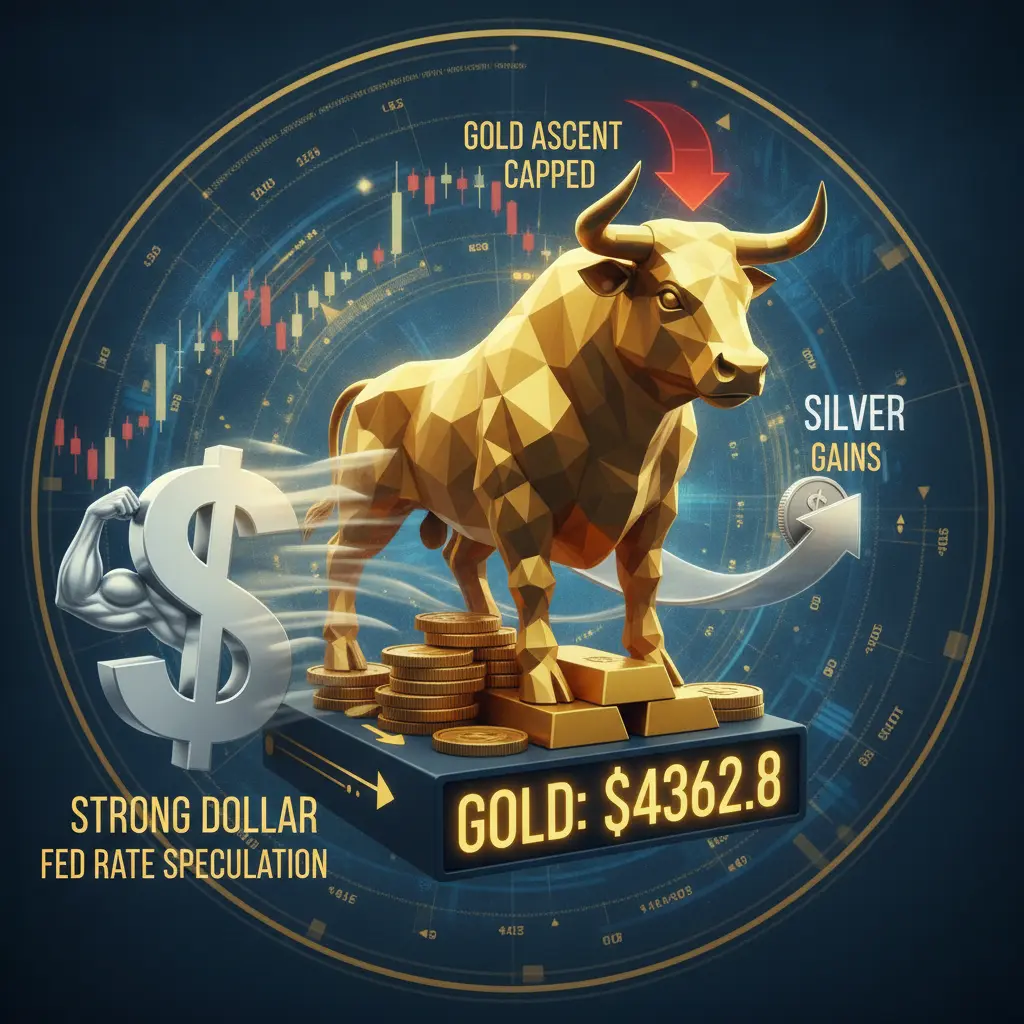
The precious metals market is exhibiting a fascinating dichotomy, with gold currently navigating a challenging environment marked by a strong U.S. dollar and evolving Federal Reserve interest rate expectations. Despite a broader rally in the metals sector, gold’s upward momentum has been largely capped, as detailed in a recent Kitco PM Report. The live Gold price currently stands at $4362.8 USD per troy ounce, remarkably stable with absolutely no change observed over the last 24 hours.
This stability, however, masks underlying pressures. A robust dollar often acts as a headwind for gold, making the dollar-denominated asset more expensive for international investors and potentially dampening demand. Furthermore, the market’s continuous repricing of the Federal Reserve’s future monetary policy, particularly regarding interest rates, plays a pivotal role. Higher interest rates typically increase the opportunity cost of holding non-yielding assets like gold, diverting investor interest towards assets that offer a yield.
In stark contrast to gold’s restrained performance, silver has emerged as a leader within the metals complex, demonstrating more pronounced gains. This divergence could be attributed to silver’s dual utility as both a monetary metal and a crucial industrial commodity. Its demand often benefits from industrial applications, which can provide a buffer against some of the macroeconomic headwinds affecting gold.
Despite these significant external forces, gold’s ability to maintain its price at $4362.8 USD per troy ounce underscores its inherent value as a safe-haven asset. While a strong dollar and central bank hawkishness may temper its short-term appreciation, the underlying demand for gold as a store of wealth persists. Investors are closely watching upcoming economic data and Fed commentary for any shifts that might provide clearer direction for the yellow metal in the weeks ahead, hoping for a catalyst to break its current range-bound trading. Read More
Leave a Reply
You must be logged in to post a comment.