
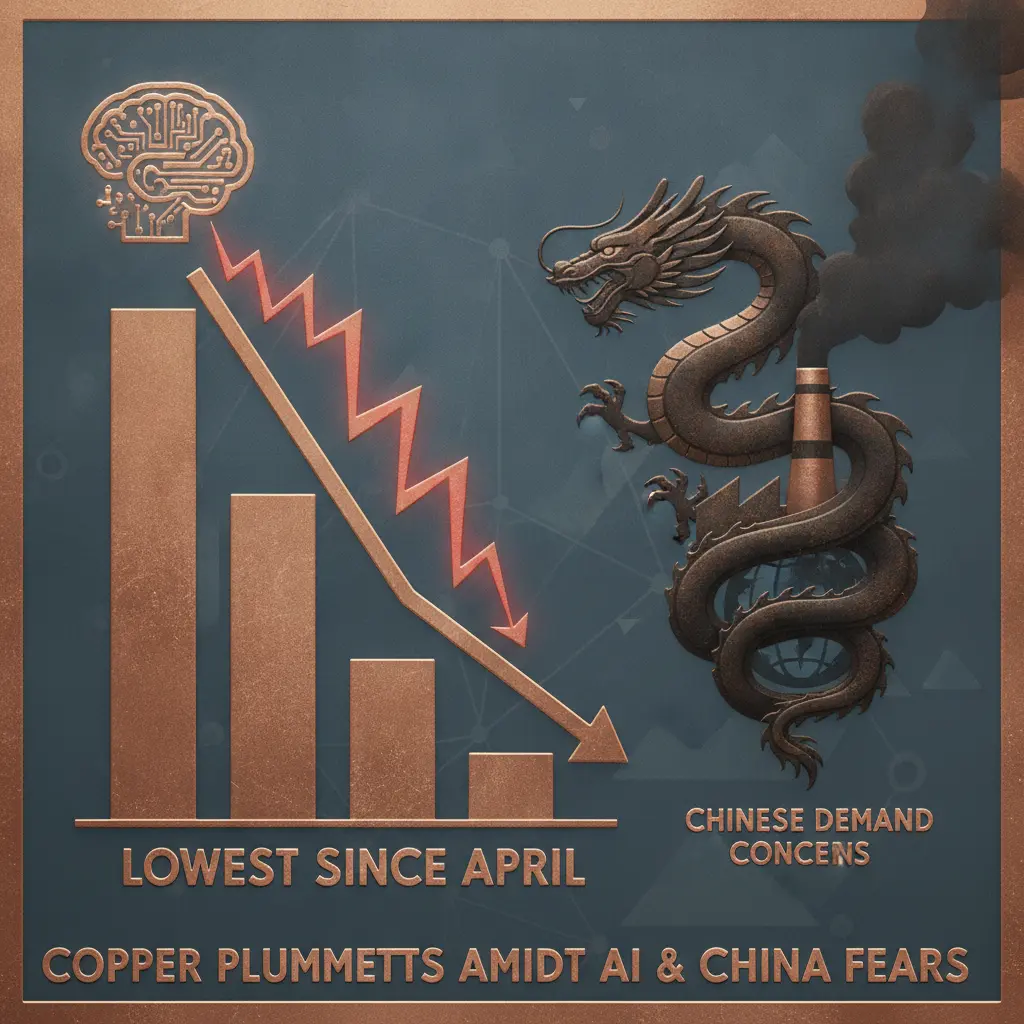
Global markets are once again casting a wary eye on industrial metals, with Copper, often seen as a bellwether for the global economy, recently dipping to its lowest price point since April. This significant downturn, highlighted by reports from the Wall Street Journal, is attributed to a confluence of factors: escalating turmoil within the Artificial Intelligence (AI) sector and persistent concerns over demand from China, the world’s largest consumer of industrial commodities.
The recent slide in Copper prices reflects a broader unease. The AI market, while innovative, has experienced periods of intense volatility, with investor sentiment shifting rapidly. This broader tech sector uncertainty can ripple through various markets, including industrial metals, as it influences projections for future manufacturing and infrastructure development. Simultaneously, the health of China’s economy remains a primary concern for commodity traders. Any signs of deceleration in its manufacturing output or property sector invariably lead to significant demand worries for foundational materials like Copper.
Despite the overarching downward trend that has brought Copper to its current multi-month lows, the immediate 24-hour trading period has shown a pause in the decline. Copper is currently trading at $0.38 USD per troy ounce, maintaining a stable position with a 0% change over the last day (a change of $0). This short-term stability might offer a momentary respite, but analysts continue to monitor global economic indicators and China’s policy adjustments closely for any sustained recovery signals. For those tracking its daily movements and market shifts, the live Copper price provides continuous updates.
Copper’s integral role in everything from construction and electronics to renewable energy infrastructure means its price fluctuations have far-reaching implications. As markets navigate AI’s evolving landscape and China’s economic complexities, the red metal’s trajectory will continue to be a crucial indicator for global industrial health. Read More
Leave a Reply
You must be logged in to post a comment.