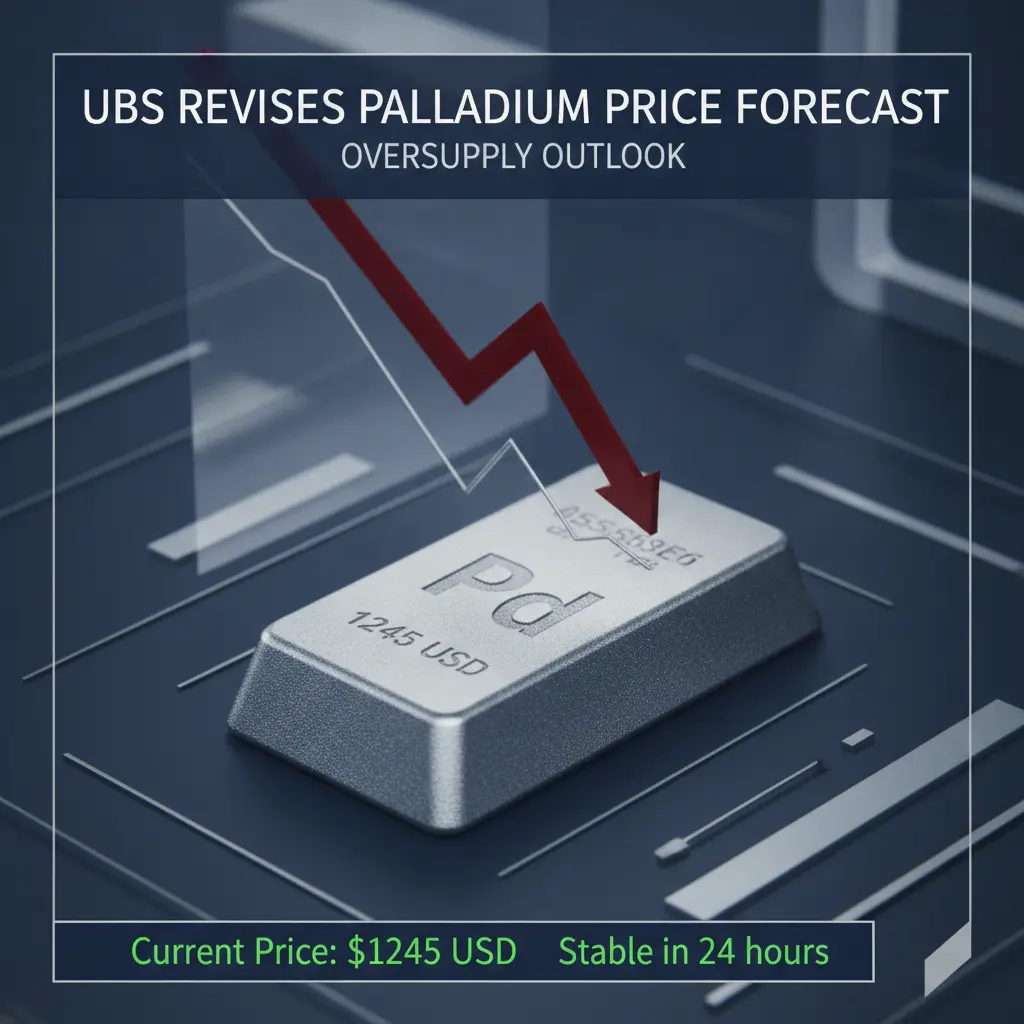
UBS, a prominent financial institution, has significantly revised its price forecast for Palladium downwards, citing a persistent oversupply outlook that continues to weigh heavily on the precious metal’s market. This development, as reported on July 28, 2026, signals a cautious stance on Palladium’s near-term future, impacting investor sentiment and strategic planning across the commodity space.Palladium, primarily valued for its critical role in catalytic converters in gasoline-powered vehicles, has seen its demand profile influenced by evolving automotive industry trends. While the metal remains essential for curbing emissions, factors such as increased recycling rates, the potential for substitution with platinum in certain applications, and a nuanced recovery in global vehicle production contribute to the perceived oversupply. Furthermore, the long-term shift towards electric vehicles, although gradual, adds another layer of uncertainty to future demand projections for platinum group metals like Palladium.Currently, the live Palladium price is holding steady at $1245 USD per troy ounce. Over the last 24 hours, the price has remained unchanged, reflecting a 0% movement or a $0 fluctuation. This stability in the immediate term contrasts with the bearish long-term outlook presented by UBS, suggesting that while the market isn’t reacting drastically day-to-day, underlying fundamentals are shaping a more subdued future for the metal.The financial institution’s updated forecast underscores the delicate balance between supply and industrial demand. With global economic uncertainties potentially impacting automotive sales and production, the supply side, particularly from major producers like Russia and South Africa, needs to be closely monitored. An enduring oversupply scenario could exert further downward pressure on prices, challenging the metal’s valuation for investors and industrial consumers alike.For those tracking precious metals, UBS’s revised outlook serves as a crucial indicator. It prompts a re-evaluation of Palladium’s position within diversified portfolios, emphasizing the importance of understanding not just current market prices but also the broader economic and industrial shifts that dictate long-term commodity trends. Read More
Leave a Reply
You must be logged in to post a comment.